
Episode 24
Listen to the Episode
Listen once for the main idea. Then use the transcript and repeat useful sentences aloud.
Download and study
Episode Resources
Download a file or continue to the transcript.
Best order: listen once, read while listening, then listen again without the text.
Full lesson
Read the Transcript
Follow the text while you listen, then repeat useful sentences aloud.
Hi, I am Georgiana, your English teacher and founder of SpeakEnglishPodcast.com. My mission is to help you to speak English fluently.
Today, I am going to talk about time prepositions in English.
And with a point of view story, you will learn grammar in context without memorizing any boring rules.
Ok. Let's start!
Prepositions are short words (on, in, to, of) that usually stand in front of nouns, pronouns, or a group of nouns.
They show direction, time, place, location, or introduce an object.
We commonly use prepositions to show a relationship in space or time or a logical relationship between two or more people, places, or things.
But today, we will focus on time prepositions.
I don't recommend memorizing the examples since that method doesn't work. It's always best to learn in context by listening repeatedly.
Ok. Let’s start learning some time prepositions in English.
We use ON before the days of the week:
Examples:
"I went to the doctor on Monday."
"Don’t call me on Sundays because I’m resting."
"I’d like to buy you lunch on Friday."
We use IN before months, times of day, years, seasons, or after a certain time period.
Examples:
"I was born in September."
"Many people go on vacation in August."
"I like running in the morning."
"My mom came back from the trip in the evening."
"Her family goes to Hawaii in winter."
"I love going to the beach in summer."
"We visited Mexico in 2010."
"My sister was born in 1998."
"I’ll see you in an hour."
"I’ll be back in 20 minutes."
We use AT for night, for the weekend, and at a certain time.
Examples:
"We sometimes finish work at night."
"Kids go to bed at 9 pm."
"I visit my family at Christmas."
We use SINCE with days or dates.
Examples:
"I haven't seen Tom since yesterday."
"She hasn’t eaten since breakfast.
"Since the party, he has not spoken to me at all."
We use the preposition FOR to indicate the length of time.
Examples:
"I haven't seen him for two years."
"She had been taking care of her mother for a year."
"I’ve waited for the bus for two hours."
We use "AGO" to determine a specific time in the past.
Examples:
"She renewed her membership about two months ago."
"Winter seems a very long time ago."
"He should have gone a long while ago."
"BEFORE and AFTER"
We use "before" and "after" to say that something happens before or after a specific time. You can use "before" and "after" with specific times, days, years, or months.
Examples:
"They never visit us before the summer arrives."
"They will visit us after the summer arrives."
"I’m hoping we can finish work before 5 pm."
"I’m hoping we can finish work after 4 pm."
Ok, that’s it for now, but before we continue…
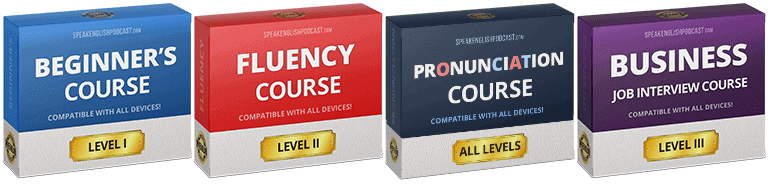
Continue practicing with my complete English courses. Choose the course that fits your level and goals, and learn to speak more naturally and confidently.
GRAMMAR MADE EASY
POV Story: Grammar in Context
Read the same story in two different points of view and notice how the grammar changes naturally.
| 01 |
First version Third Person · Past Tense |
Nick was an expert in writing business value propositions, highly appreciated among entrepreneurs. He decided to set up an academy to teach what he did best. He placed an ad in a newspaper, and soon dozens of people signed up for his course.
On the first day of the course, Nick was delighted, but when the class started, the students started asking all kinds of questions related to using prepositions in English. Nick didn't understand what was going on. Finally, a student showed him the newspaper ad. It said, "Course on prepositions of value. 50% discount only this month."
There was a typo in the ad, so it was all a misunderstanding. The English students didn't learn much about prepositions but value propositions.
What a mix-up! A value proposition is a simple statement that summarizes why a customer would choose a product or service. It communicates the clearest benefit received.
| 02 |
Second version First Person · Future Tense |
Hi, I'm Nick, an expert in writing business value propositions, highly appreciated among entrepreneurs. I'm sure that I will probably set up an academy to teach what I do best. I will place an ad in a newspaper, and soon dozens of people will sign up for my course.
On the first day of the course, I will be delighted, but the students will start asking questions about using prepositions in English. I will not understand what's going on. Finally, someone will show me the newspaper ad. It will say, "Course on prepositions of value. 50% discount only this month."
There will be a typo in the ad, so it will all be a misunderstanding. The English students won't learn much about prepositions but value propositions.
Okay! That's the end of this little exercise. Notice that the changes between grammar points are subtle but important.
My advice is not to try to memorize grammar rules. It's better to see the changes in the proper context. With a story it is much easier to remember all this.
Thanks for listening, and I’ll see you in the next episode.
Review
Vocabulary
Review the most useful words and expressions before listening again.
Preposition
A short word that shows relationships such as time, place, or direction.
On
A time preposition used before days of the week.
In
A time preposition used before months, years, seasons, parts of the day, and periods of time.
At
A time preposition used for specific times, night, weekends, and some holidays.
Since
Used to show the starting point of a period of time.
For
Used to show the length or duration of time.
Ago
Used to refer to a specific amount of time before the present.
Before / after
Used to show that one event happens earlier or later than another.
Continue practicing with my complete English courses. Choose the course that fits your level and goals, and learn to speak more naturally and confidently.

I learnt to English. You are helping me
Hi! Start with the free video course: https://speakenglishpodcast.com/method
Thank you so much teacher I’m learning a lot from you, I have question how do I khow what my level in English.