
Episode 21
Listen to the Episode
Listen once for the main idea. Then use the transcript and repeat useful sentences aloud.
Download and study
Episode Resources
Download a file or continue to the transcript.
Best order: listen once, read while listening, then listen again without the text.
Full lesson
Read the Transcript
Follow the text while you listen, then repeat useful sentences aloud.
Hi, everybody! I am Georgiana, your English teacher and founder of SpeakEnglishPodcast.com. My mission is to help you speak English fluently.
In this episode:
I'll talk about a Japanese technique called Kaizen. It's hard to be constant when you have a long-time project like learning English. This technique will help you to study English every day, and it will prevent you from procrastinating.
Later you'll practice your speaking skills with a new mini-story.
What in the world is Kaizen? You may be asking yourself.
Kaizen is a Japanese word that can be translated as "Continuous Improvement."
The concept of continuous improvement has been around for thousands of years in Japanese culture.
Here's the thing, sometimes we want to achieve essential goals or make significant changes to our habits.
It's when we get excited, and we start taking massive action.
We go to the gym five days a week or study English for several hours every day.
This is easy when we begin since we're motivated, and we have strong determination. Novelty gives us that feeling.
Taking massive action can be positive sometimes. Unfortunately, many times it can become counterproductive.
This mindset is prevalent among western culture. We like finding big solutions to big problems.
The best way to reach your goal is to start using a better and more efficient method.
So, you have already chosen your goal. That's easy to do. You've decided that you want to speak English fluently.
What's tricky is maintaining your enthusiasm until reaching your goal.
Don't try to make radical changes in a short amount of time; make small improvements every day.
These small steps will gradually lead to your aim.
Each day, just focus on getting 1% better. In your case, just focus on improving your English skills by 1% every day.
It might not seem like much, but those 1% improvements start compounding on each other.
For example, we all know that it's hard to keep on doing the same routine every day.
But it can also be fun. That's why you should choose your material carefully. It shouldn't be complicated or tedious. And most of all, don't let your lack of time become an excuse. Start with ten or even 5 minutes per day.
Why does Kaizen work?
When you improve a little each day, eventually, remarkable things occur.
Not tomorrow, not the next day, but in the end, you achieve something significant.
Sadly, many English students spend years looking for the perfect method. They're looking for that big trick that will make them speak English with fluency from one day to another.
Instead, the Kaizen way reminds you to focus on your primary task and do a little every day.
You already know what you need to do. Get to work and find small ways to improve along the way.
Start small and make your increases gradual. Avoid the temptation of getting impatient. Don't start rushing forward and taking bigger leaps. Take it slow, steadily, and be consistent.
Now let's try to apply the Kaizen philosophy to this specific example. Let's say you only spend 10 minutes reading ten pages a day. You can do that just before going to bed. It's only for 10 minutes.
Now, let's do some math. Ten pages per day, that's 300 pages in a month. Not bad, huh?
Let's keep doing the math. In one year, you would read twelve books, and in 5 years, 60 books!!! Can you imagine that? Can you picture how many words, expressions, grammar structures you could learn?
You could also start writing three pages per day, listen 15 minutes in the morning and 15 in the afternoon, or even speak English for 10 minutes every day. It's up to you.
If you're curious to know more about the Kaizen way, there are many books on this topic. I can recommend you, "A small step can change your life," by Robert Maurer. Maybe you could read it, a few pages a day, in English. 🙂
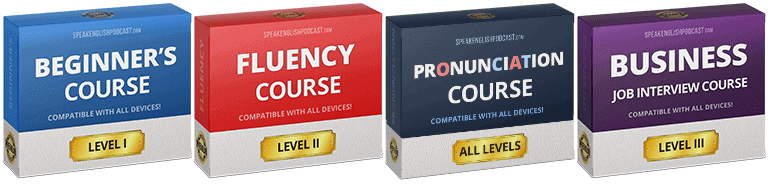
Continue practicing with my complete English courses. Choose the course that fits your level and goals, and learn to speak more naturally and confidently.
IMPROVE YOUR SPEAKING
Mini-Story: Speaking Practice
Answer the questions aloud with short and quick responses. Repeat the Mini-Story several times to improve your speaking and listening.
Joe was a very lazy guy with no energy.
Who was a lazy guy?
Joe. He was a very lazy guy.
Was Joe lazy or active?
Lazy. He wasn't active. He was very lazy.
Did he have any energy?
No. He didn't have any energy.
Joe was very active, right?
No. Not at all. He wasn't active. He was very lazy.
Was Joe a guy or a guide?
A guy. A man. Not a guide. And he didn't guide anyone either.
His doctor advised him to do at least 30 minutes of exercise a day.
Did Joe need to rest for 30 minutes every day?
No. No. He needed to exercise. Not rest.
His mother advised him to exercise every day. Right?
No. His mother didn't advise him. His doctor told him to exercise at least 30 minutes every day.
Whose doctor advised Joe to exercise?
His doctor. Joe's doctor advised him to do exercise.
Did his doctor need to exercise every day at least 30 minutes?
No. Not his doctor. Joe. He needed to exercise.
How many minutes did Joe need to exercise every day?
Joe needed to exercise at least 30 minutes every day.
Joe decided to apply a Japanese philosophy called Kaizen. He started walking 1 minute a day.
Did Joe decide to go surfing every day?
No. He didn't decide to go surfing every day. He decided to follow the Kaizen way.
Joe decided to walk for 10 minutes every day. Right?
No. Not 10 minutes. He's started walking only 1 minute a day.
Did he start learning Japanese?
No. He started following a Japanese method called Kaizen.
The first month he walked for 30 minutes a day. After six months, he started running for one hour a day.
How many minutes could Joe walk after one month?
30 minutes. He could walk for 30 minutes.
Could Joe run in the first month?
No. He couldn’t run in the first month. He could walk for 30 minutes, though.
Joe could run for 10 hours after six months. Right?
No. Not 10 hours. After six months, Joe could run for one hour a day.
After a year, he participated in a marathon and finished it effortlessly.
Did Joe visit Manhattan after one year?
No. No. He participated in a marathon.
After how many years did Joe participate in a marathon?
After one year, Joe participated in a marathon after one year.
Was the marathon too tiring for Joe?
No. The marathon wasn't too tiring. He finished it effortlessly.
Did the Kaizen method help Joe become active?
Yes. The Kaizen method helped Joe become very active.
Look at Joe! He's amazing! One year ago, he didn't have any energy at all. He couldn't even walk for 30 minutes. Now he's ended up running marathons! And yes, you can also apply it to learning English or anything else you want.
Thanks for listening, and I’ll see you in the next episode.
Review
Vocabulary
Review the most useful words and expressions before listening again.
Kaizen
A Japanese concept meaning continuous improvement through small, steady changes.
Continuous improvement
The process of getting gradually better over time.
Massive action
A very large amount of effort made all at once.
Counterproductive
Having the opposite effect from the one you intended.
Determination
A strong intention to keep working toward a goal.
Compound
To build up progressively as small improvements add to one another.
Gradual
Happening slowly in small steps.
Consistent
Continuing to do something regularly and steadily.
Continue practicing with my complete English courses. Choose the course that fits your level and goals, and learn to speak more naturally and confidently.

Obrigado Georgiana
Estou acompanhando seus podcast que são ótimos.
Sua voz é super agradável
Thanks and congratulations, Georgiana, for your excellent English course!
I started listening to your podcast three months ago, and I feel that my English skills have improved considerably. The technique, texts and the way of conducting the course are unique and very effective.
Mauro Cruz
Juiz de Fora
Brazil
Hi, Mauro! Thank you for your positive feedback. I’m so happy that the podcast is working so well for you!!
Hi Georgiana,
I just saw the inclusion of my comment in the 54th lesson. My wife was listening to your Podcast and by chance she heard my name in this lesson. She came immediately to me and showed me. She is very interested in the course and she is loving the technique, ” without boring exercises or memorizing rules. ”
Thank you for considering my comment.
Mauro Cruz
Brazil
Hi Mario! Your comment was great and I wanted to share it with all of my listeners. I’m glad that you and your wife find my method useful. Have a nice day!
I find this teaching very fascinating and effective as acompared to other methods.
I’ve discovered these podcasts today. The new words are being learnt much faster and are being remembered much better. Thanks for your great work!
Hi, Sergei. I’m very happy that you’re enjoying my lessons.
Good morning my teacher Georgiana
your way to teach is wonderful
thank you so much
have a great time
Hi Georgiana, my prefered English teacher.
How have you been doing? I hope well.
I am writing to thank you for all you have given me through your English classes. Studying English with you, means much more than learning a language. It is like immersing myself in a culture, learning to think differently and finding tips that serve many different areas of knowledge and development of multipurpose tools (like Kaizen).
Sincerely, thank you tons !!.
Dan
Uruguay
Hey Georgiana , how have you been doing ? I hope well .
I wanna thank you . your lessons are amazing . I like this way of teaching .
and about this topic I agree with Japanese and its a good way for me and I decided to read a book about Kaizen without any procrastination .
Hi Georgiana, I want to express my great appreciation to you and say thank you so much for your work. Your podcasts help me a lot in learning English. I think your teaching method is one of the best. Thanks to your podcasts I have a better understanding of English speech. Thank you again.