
Episode 5
Listen to the Episode
Listen once for the main idea. Then use the transcript and repeat useful sentences aloud.
Download and study
Episode Resources
Download a file or continue to the transcript.
Best order: listen once, read while listening, then listen again without the text.
Full lesson
Read the Transcript
Follow the text while you listen, then repeat useful sentences aloud.
Hi, everybody! I’m Georgiana, founder of SpeakEnglishPodcast.com. Welcome to a new episode of the Speak English Now podcast!
Today, we’re going to talk about something many English learners get wrong.
Should you speak more… or listen more?
Should you write more… or read more?
And after that, we’ll practice speaking with a Mini-Story.
Okay. Let’s get started!
When people want to speak English, they often hear the same advice:
“Just speak more.”
“Find a conversation partner.”
“Write every day.”
This sounds logical. If you want to speak, you should speak. If you want to write, you should write.
But after teaching English for many years, I see the same situation again and again.
Students try very hard to speak. They join conversation groups. They push themselves to produce English.
And still, they hesitate. They translate. They search for words.
The problem is not always effort. Sometimes the problem is balance.
Listening and reading are input. They are how you receive English.
Speaking and writing are output. They are how you use English.
You can’t produce what you haven’t first taken in.
Think about cooking.
If you have never tasted a soup, never watched someone make it, and never seen the ingredients, it will be very hard to cook that soup well.
You can stand in the kitchen and “practice cooking” all day. But without enough examples, you keep guessing.
English works in a similar way.
If you don’t hear enough natural English, speaking feels like guessing.
If you don’t read enough clear English, writing feels like translating word by word.
So no, speaking and writing are not a waste of time.
They are useful. Very useful.
When you try to speak, you notice what you cannot say yet. The next day, when you listen again, your brain pays more attention to those missing pieces.
Speaking shows you the gaps. Listening fills the gaps.
But if most of your time is speaking with other students who also hesitate, you don’t get enough good English to copy.
A better plan looks like this.
Listen a lot to English you can understand.
Then speak a little, with focus.
For example, you can listen for about one hour a day. A podcast. A course. A short audio story at your level. You can do this while walking, cooking, or driving. And this reminds me of my conversation with my student Paola from Milan. She just told me she listens for about 2 to 3 hours every day. While cleaning, cooking or walking her dog and also before going to bed. And we also meet every Monday online to have our weekly conversation class. But let’s get back to our lesson.
So, start listening every day for about one hour. Then practice speaking once or twice a week. With a tutor. With a friend. Or with the Mini-Stories in this podcast.
Little by little, listening feeds your speaking.
And reading feeds your writing.
That’s why this podcast focuses so much on listening and responding.
You hear English you can follow. You answer easy questions. You repeat.
You don’t need a perfect conversation every day. You need enough understandable English so that the words are already there when you need them.
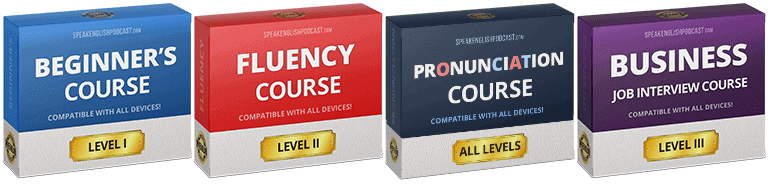
Want more speaking practice? Continue with a complete audio course.
IMPROVE YOUR SPEAKING
Mini-Story: Speaking Practice
Answer the questions aloud with short and quick responses. Repeat the Mini-Story several times to improve your speaking and listening.
Okay. Let’s practice.
Remember: I’ll give you some information. Then I’ll ask you very easy questions. Try to answer out loud before I give you the answer.
Let’s start!
Maya started a new job in a café in London.
Did Maya start a new job?
Yes. She started a new job.
Did she start a job in a hospital?
No. Not in a hospital. In a café.
Where was the café?
In London. The café was in London.
Maya didn’t know much English.
Did Maya speak fluent English?
No. She didn’t.
Did she know a lot of English or only a little?
Only a little. She didn’t know much English.
The customers ordered coffee, tea, and cake.
Did the customers order pizza?
No. Not pizza.
What did they order?
Coffee, tea, and cake.
Maya was nervous, so she asked people to point at the menu.
Was Maya relaxed?
No. She was nervous.
Did she ask people to point at the menu?
Yes. She did.
Did that help her a little?
Yes. It helped her a little.
But Maya wanted to understand the conversations around her.
Did she want to understand more English?
Yes. She did.
Did she only want to study grammar rules?
No. She wanted to understand the conversations.
So Maya listened. Every day. While she worked.
Did Maya listen once a month?
No! She listened every day.
Did she listen at work?
Yes. She listened while she worked.
At first, she only caught a few words.
Did she understand everything at first?
No. She didn’t.
Did she catch a few words?
Yes. A few words. Words like coffee, tea, please, and thanks.
After two months, the same phrases started to feel familiar.
Did the English feel more familiar?
Yes. It did.
Did it happen in one day?
No. After two months.
Soon Maya could use short sentences at work.
Could she give long speeches?
No. Only short sentences.
Were the sentences related to work?
Yes. They were related to work.
“Small coffee, please.” “Here you are.” “Enjoy your cake.”
Maya also went out with her colleagues.
Did she stay home every evening?
No. She went out with her colleagues.
Could she practice listening there too?
Yes. She could.
The conversations were relaxed, so she felt less nervous.
Did she feel more nervous or less nervous?
Less nervous.
After one year, Maya could have real conversations.
Could she only point at the menu after one year?
No. Not anymore.
Could she talk with customers and friends?
Yes. She could.
Maya was happy. She didn’t learn English by speaking all day with no input.
Did she only speak, with no listening?
No. She didn’t.
What helped her most?
Listening first. Then speaking a little.
Little by little, the English she heard became the English she could use.
Excellent! That’s the end of the Mini-Story.
Remember, you can replay this section and answer the questions another time. The goal is to respond quickly.
If you want to speak more easily, give your brain enough English to work with.
Listen more than you speak. Then, when you speak, you will have something ready to say.
You can get the transcript for this episode at SpeakEnglishPodcast.com/podcast.
And if you want more structured listening and speaking practice, you can check out my premium courses at SpeakEnglishPodcast.com/courses.
Thanks for listening, and I’ll see you in the next episode!
Bye-bye!
Review
Vocabulary
Review the most useful words and expressions before listening again.
input
English you receive by listening or reading.
output
English you produce by speaking or writing.
balance
the right mix of different activities.
hesitate
to pause because you are not sure.
produce
to create or use language yourself.
familiar
easy to recognize because you have heard it before.
gap
something missing; a part you cannot do yet.
understandable
clear enough to follow.
colleagues
the people you work with.
relaxed
calm; not nervous.
related to
connected with a topic.
feed
to give something what it needs to grow.
Want more speaking practice? Continue with a complete audio course.

thank you very much
You’re welcome 🙂 Obrigada!
I am from India .how much I have to pay tell me gorgiana
hey there we can be a friends and practice the english language if you want to
this is my gmail for more enfos : mundoalaoui@gmail.com
Thanks for taking time to make these audios and videos to helping us. God bless you!
Hi Nelvin! I’m happy that you like my lessons!!
I’m studying with your podcasts! They are the best for me! Thank you so much!
Thank you so much Georgiana teacher.this episode is very useful for me
Thank you so much for taking the time to record your podcast. Each of your little stories adds new vocabulary to me and makes my English better. Thank you very much.
Hi Georgiana,
I want to speak english
can you help me?
I went to speaking English you may help me.
I heard some of you audio
I like it ,
Thank you very much
Georgiana is awesome! I like so much of the content of podcasts! Every days I listen ! Thank you Georgiana! Best regards!
Hi, Jorge! Thanks for the comment! Have a nice summer!
Hello GEORGIANA.
Thanks for your awesome podcast.
Hi dear madam! I am delighted get this kind of method of learning English. Really it’s a very easy method.
Hi GEORGIANA.
Thanks a lot for your podcast.
I so glad to listen to your podcasts and I recommend other students use your podcasts for learning English. This is cool to learn English with your lessons .
Have a nice day.
The podcast makes me addicted to English
Thank you Georgiana
That’s just awesome! Keep up with the good work!!
Thanks so much Georgiana! From Ecuador… I am improving a lot!
i love your way to teach english !!
Thank you, I love this way it’s enjoyable really I live it.
Thank you for making me understand easily on listening, reading, Writing and speaking
Thanks for your help me. You are the best. God bless you.
thank you for you sincerely prepared lessons.
These podcasts is very useful for me. I aware that my English is improving step by step thanks to your podcasts
I can’t thank you enough.
good
it is perfect